
OSENC Magnetic Separation
Magnetic Separation for Plastic Recycling Lines
Plastic recycling usually needs more than one magnetic protection point. Remove large steel before shredding or granulation, separate exposed ferrous pieces after size reduction, and use close-contact magnetic tubes, grates, or drawer magnets before sensitive extrusion, blending, or packing equipment. The correct sequence depends on the plastic form, moisture, particle size, and contamination source.
Send Plastic and Line Details View Magnetic Product Families
Identify the Contamination Before Choosing Equipment
| Contamination | Likely source | Why the location matters |
|---|---|---|
| Bolts, tools, nails, and large wire | Collected waste, baling, transport, maintenance | Remove before shredder or granulator damage |
| Small steel clips and fragments | Packaging, labels, closures, shredded assemblies | Often become more exposed after size reduction |
| Fine iron and wear particles | Knives, screens, conveyors, mills, screws | Close-contact separation is usually needed near final feed |
| Stainless, aluminum, or copper | Mixed scrap and equipment components | May require metal detection, eddy-current, sensor, or other technology |
Recommended Separation Points
- Before the primary shredder: review a suspended magnet for exposed tramp iron on a conveyor.
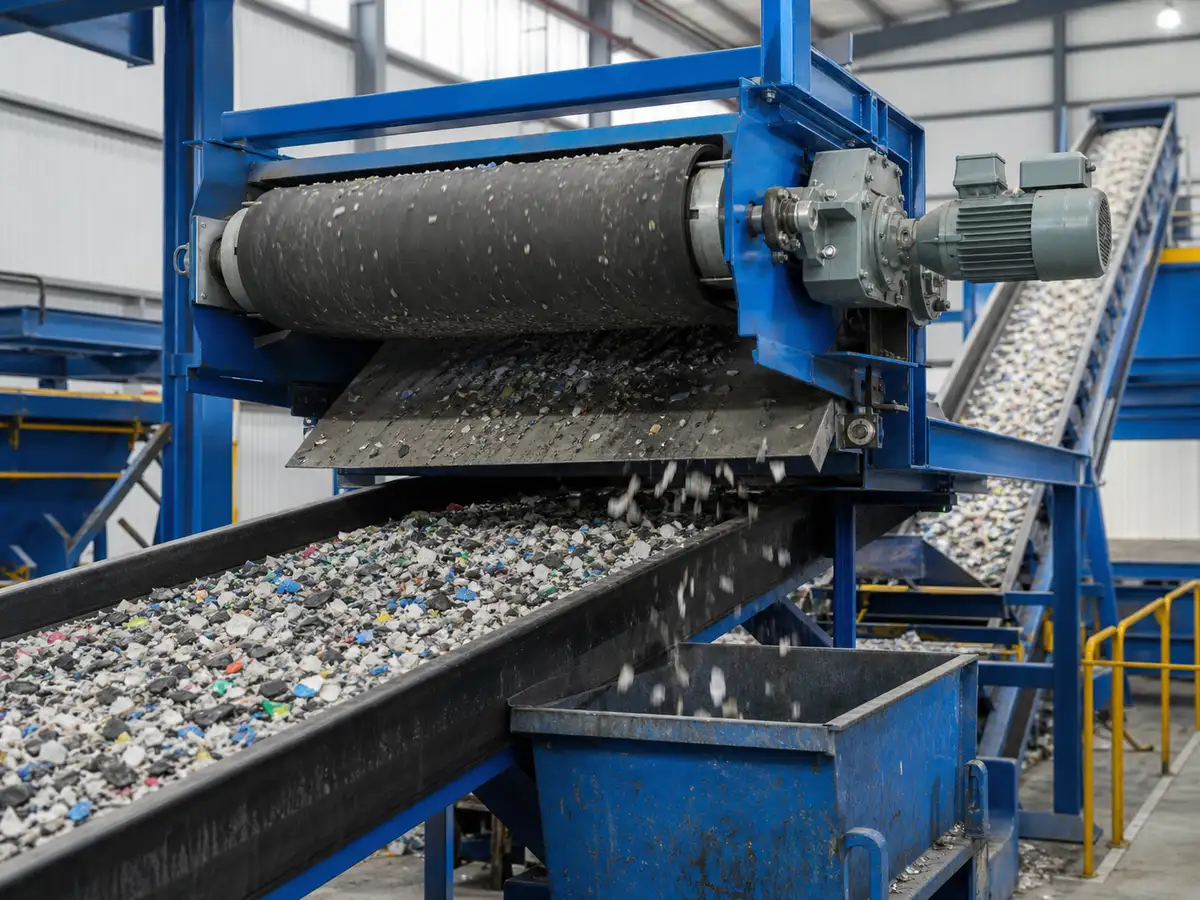
- At a conveyor discharge: review a magnetic head pulley or drum when ferrous and non-ferrous trajectories can be separated.
- After granulation: a drum can provide continuous separation if feed is thin, distributed, and suitably dry.
- Before extrusion or packing: review a grate, tube, drawer magnet, or easy-clean grate for free-flowing flakes or pellets.
One magnet at the end cannot reliably protect upstream machinery. Conversely, an overband designed for large tramp iron should not be treated as the only control for fine wear particles.
Plastic Form Changes the Recommendation
- Rigid regrind
- Usually flows better than film but can contain sharp wire and dense metal pieces.
- Film and light flakes
- Can flutter, cling through static electricity, and travel unpredictably at a discharge.
- Wet flakes
- Water and agglomeration can hide particles and cause buildup; dry-magnet performance must be tested under actual moisture.
- Pellets
- Generally free-flowing and suitable for close-contact magnetic protection, subject to temperature and cleanliness requirements.
- Mixed e-waste plastic
- May contain non-ferrous and weakly responsive metals that require additional separation technologies.
Drum, Suspended Magnet, or Grate?
| Product | Best first use | Main limitation |
|---|---|---|
| Suspended magnet | Large exposed tramp iron above a conveyor | Fine iron buried in a deep moving layer |
| Head pulley or magnetic drum | Continuous removal at a controlled discharge | Needs stable feed and a defined splitter/discharge path |
| Grate, tube, or drawer magnet | Fine ferrous contamination in gravity-fed flakes or pellets | Can bridge, require frequent cleaning, or suffer impact from large pieces |
Control Feed Depth and Distribution
A magnetic separator works on the material that enters its effective field. Spread the material across the working width and avoid surges that create a deep center layer. For drums and pulleys, document speed, feed position, splitter position, and discharge trajectory. For grates and drawers, balance close contact against open area and blockage risk.
How to Verify Performance
Use a representative sample containing the actual plastic, moisture, particle distribution, and contamination. Record feed mass, collected ferrous fraction, residual contamination measurement, operating settings, and repeat runs. Do not convert a visual demonstration into a guaranteed recovery percentage without a controlled method.
Common Mistakes
- Assuming all metal is magnetic
- Testing clean dry flakes when production material is wet or dusty
- Allowing a thick surge layer over a drum or under an overband
- Installing magnetic tubes where large sharp pieces can dent them
- Cleaning only after captured iron shields the collection surface
- Ignoring metal generated by downstream wear after the last magnet
Information for a Plastic Recycling Review
Send plastic type and form, particle-size range, moisture, capacity and peak feed, contamination photographs, process flow diagram, current equipment, proposed installation points, belt or chute dimensions, cleaning frequency, and required residual-metal acceptance method.
Buyer Data for a Plastic-Recycling Separation Decision
Use these inputs to decide whether the proposed separator and process position fit the real operating duty.
| Equipment direction | A suspended magnet suits exposed steel before shredding, while a drum or head pulley is usually reviewed after size reduction when liberated wire and small ferrous pieces need continuous discharge. |
|---|---|
| Material condition | Define polymer type, rigid or film fraction, flake size distribution, moisture, bulk density, electrostatic behavior, tangling tendency and whether labels, fibers or fines affect flow. |
| Target iron or magnetic fraction | List steel wire, screws, blades, cans, clips and wear fragments; distinguish free pieces from wire embedded in plastic and state the acceptable residual risk for the next machine. |
| Throughput and presentation | Provide normal and peak kg/h or t/h, conveyor width and speed, actual layer depth, feed surges and whether a metering conveyor spreads the material across the full width. |
| Installation and access | Confirm the separator position before or after shredding, available drop height, splitter and discharge space, guarding, dust extraction and access for removing wrapped wire. |
| Test or acceptance | Test representative mixed flakes with the real wire shapes and moisture condition. Measure captured ferrous material, missed targets and saleable plastic carried into the magnetic fraction. |
Engineering Conditions Behind the Recommendation
- Do not select from a surface Gauss value alone.
- Review field strength and gradient at the rated working distance, including the conveyor belt, burden depth and any protective plate.
- Belt speed, feed uniformity, target size, shape and magnetic response determine how much time and force are available for capture.
- Mechanical passage capacity is not the same as effective separation capacity.
- Quote or test conditions must identify material, size distribution, moisture, bulk density, normal and peak rate, feed distribution, speed, layer or flow geometry, contamination loading and cleaning interval.
What We Need to Configure This Project
Input set for Magnetic Separation for Plastic Recycling Lines
- How we use your data: We compare your material, contamination risk, production target and line interface before we configure a proposal or rule out an unsuitable option.
- Material: name and composition; dry or wet; powder, granule, lump, fibre or slurry; minimum, maximum and typical particle distribution; moisture, stickiness, tendency to cake or bridge, abrasiveness, corrosiveness, bulk density, normal temperature and maximum temperature.
- Production and target: normal and peak throughput, continuous or batch feed, feed uniformity, contaminant or recovery target, magnetic response if known, typical and maximum target size, initial concentration, acceptable residual and whether product loss is permitted.
- Installation: belt width and speed, normal and maximum burden depth, magnet position and rated working distance, available suspension and maintenance space, support and lifting arrangement; cleaning method, permitted shutdown, contact-material, wear and corrosion requirements; indoor, outdoor, washdown, high-humidity, dusty or hazardous-area conditions.
- Supporting project files: drive voltage, frequency and phase where a self-cleaning unit is considered; control interface and any site air requirement; destination country; current drawings, site photographs, running video and a representative material/contaminant sample when testing is needed.
- What you receive next: We use the confirmed inputs to prepare a project-specific drawing and inspection plan. We do not treat performance as confirmed until the agreed design and any required representative test or site acceptance establish the result.
Project Support
Send your material and process conditions
We can review the process point, material shape, iron source, capacity, available space and cleaning method before recommending a magnetic separator layout.
Frequently Asked Questions
Why is “Recommended Separation Points” important for this decision?
One magnet at the end cannot reliably protect upstream machinery. Conversely, an overband designed for large tramp iron should not be treated as the only control for fine wear particles.
Why is “Control Feed Depth and Distribution” important for this decision?
A magnetic separator works on the material that enters its effective field. Spread the material across the working width and avoid surges that create a deep center layer.
How to Verify Performance?
Use a representative sample containing the actual plastic, moisture, particle distribution, and contamination. Record feed mass, collected ferrous fraction, residual contamination measurement, operating settings, and repeat runs.