
OSENC Magnetic Separation
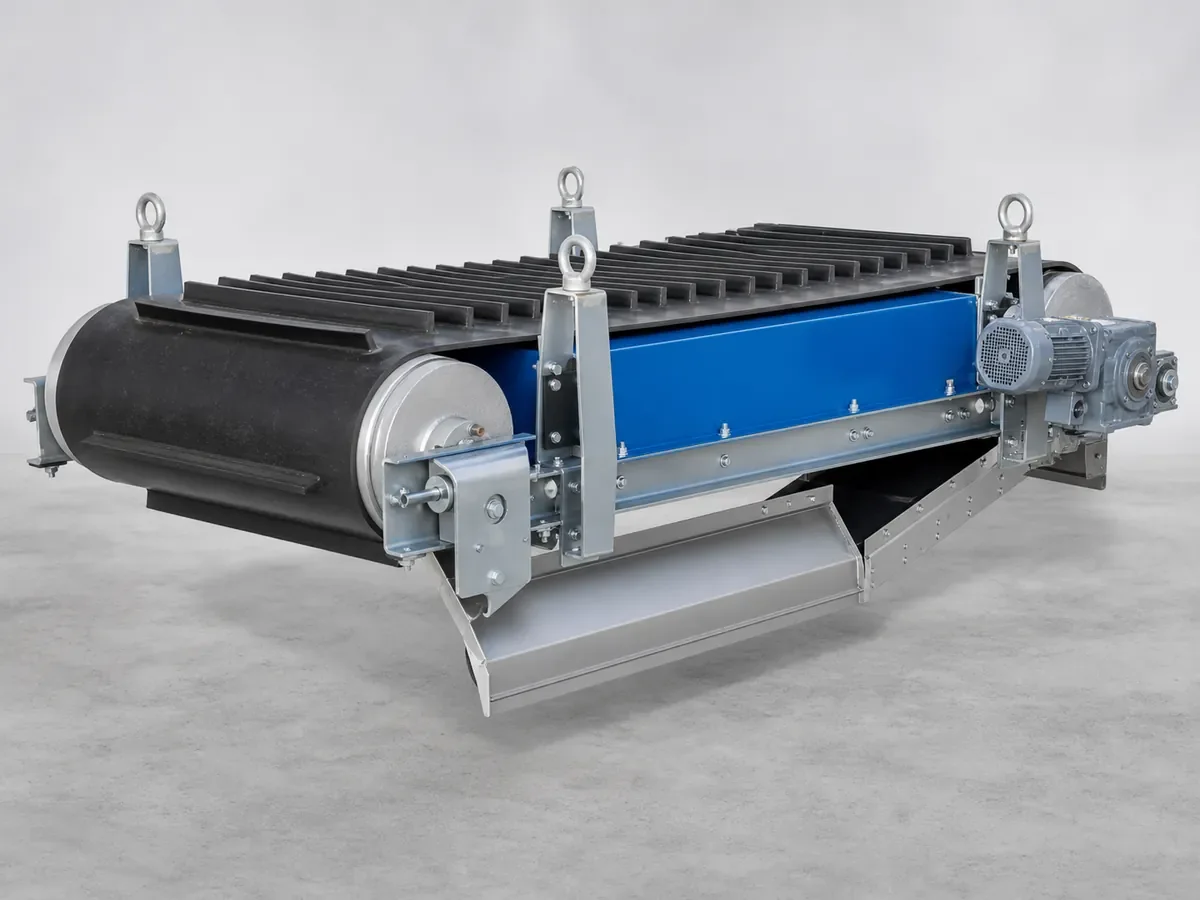
Self-Cleaning Permanent Overband Magnet
Continuous Automatic Iron Discharge
A self-cleaning permanent overband magnet combines a permanent suspended magnetic circuit with a short motor-driven cleaning belt. It is reviewed when tramp iron arrives frequently, the main conveyor operates continuously, or manual cleaning would cause excessive shutdown or unsafe buildup.
Send Conveyor and Discharge Layout Compare Manual-Clean Suspended Magnet
Magnetic Power and Motor Power Are Different
The permanent magnetic circuit requires no excitation power. The motor drives the cleaning belt that carries captured iron out of the active field. A specification must list cleaning motor/reducer data separately and must not describe that value as magnetic excitation power.
Choose Crossbelt or Inline
| Layout | Typical use | Check |
|---|---|---|
| Crossbelt | Cleaning belt discharges to the side of the main conveyor | Side clearance, support, iron collection, trough geometry |
| Inline | Cleaning belt generally follows the main material direction near discharge | Head-pulley trajectory, splitter, longitudinal space |
The final choice must preserve rated working height and ensure the largest captured piece clears the main belt, guards, and structure.
Selection Inputs
- Main belt width, trough angle, speed, and material burden
- Target iron size, shape, amount, and frequency
- Magnet face-to-belt and face-to-burden references
- Available width, length, height, lifting, and maintenance space
- Discharge direction and collection-bin position
- Ambient/material temperature, dust, rain, corrosion, and impact
- Site voltage, control scope, and operating hours
Cleaning-Belt and Drive Data
The approved project should define belt width, material, cleats or reinforcement where applicable, pulley/roller arrangement, take-up, tracking adjustment, bearings, motor, reducer, guards, rotation, and spare-parts scope. Weather cover, belt-misalignment switch, speed monitoring, or control cabinet must be quoted only when confirmed.
Standard Configuration Range
| Item | Standard offering |
|---|---|
| Main conveyor belt width | 500–1,600 mm |
| Rated magnet-face-to-belt distance | 150–450 mm |
| Main conveyor speed | Up to 3.5 m/s |
| Cleaning belt width | 650–1,800 mm |
| Cleaning belt speed | 1.5–2.5 m/s |
| Drive power | 1.5–7.5 kW according to frame and belt size |
| Standard electrical supply | 380 V, 50 Hz, three-phase; destination supply available by order |
| Motor protection | IP55 standard |
| Discharge layout | Crossbelt left/right discharge or inline discharge |
| Normal material temperature | Up to 80°C |
Commissioning
- Check frame condition, suspension, guards, fasteners, and clearance.
- Jog the drive and confirm rotation before continuous running.
- Track and tension the cleaning belt under the product manual.
- Run without feed and inspect noise, vibration, bearings, and discharge.
- Introduce material gradually and verify iron clears the main stream.
- Record installed height, burden, speed, and representative test results.
Common Failure Causes
- Magnet installed above its rated working height
- Insufficient clearance for captured iron
- Cleaning belt running or tracking incorrectly
- Iron discharge returning to the product stream
- Deep surges hiding iron below the useful field
- Sharp or hot iron damaging the cleaning belt
Inspection and Documentation
Project records may include approved dimensions, magnetic test at defined points/height, belt tracking, no-load trial, motor/reducer documents, photographs, packing, and maintenance guidance. Identify whether OSENC, the manufacturing partner, or a third party produces each record.
Request a Project Review
Send conveyor drawing, burden data, iron photographs/frequency, installation position, discharge direction, operating environment, power supply, control requirement, and available access.
Self-Cleaning Overband RFQ Inputs
The quotation should describe conveyor material with continuous or frequent tramp-steel removal and connect each proposed feature to an operating or acceptance requirement.
| Selection logic | Use a self-cleaning belt when iron loading, production continuity or access makes repeated manual cleaning impractical. |
|---|---|
| Application inputs | Material, particle and lump size, bulk density, moisture, belt width, speed, burden profile, target steel and expected iron loading |
| Mechanical interface | Specify crossbelt or inline orientation, discharge side, support steel, power supply, drive and belt details, guarding and bin clearance. |
| Cleaning and service | Define belt inspection, tracking and tension checks, scraper or discharge condition, bearings, gearbox and safe lockout access. |
| Acceptance method | Agree working-height capture test, belt no-load run, tracking, rotation, dimensions and the documents for supplied electrical and mechanical components. |
Project Scope and Supply Boundary
Boundary for Self-Cleaning Permanent Overband Magnet
- We supply self-cleaning permanent overband magnets in the standard configuration range described here.
- The approved drawing fixes belt width and speed, burden depth, rated suspension height, target iron, cleaning-belt structure, drive, guards, discharge direction and structural interface.
- Dimensions, magnetic values, pull force, capacity, separation result, materials, certification, lead time and warranty become project facts only in traceable quotation, drawing, inspection or order documents.
Safety Boundary Before Installation, Cleaning or Maintenance
- Before access, isolate and lock out the conveyor, separator drive and connected equipment under the site procedure; verify that movement cannot restart. A permanent magnet remains active after electrical isolation. Control suspended loads, pinch and nip points, attracted tools, loose steel, sharp collected iron and safe access around the belt and discharge zone.
- People with pacemakers or magnetically sensitive medical devices must follow medical-device and site restrictions; protect sensitive electronics and magnetic media.
- Our guidance is not a complete safe-work procedure. Approved manufacturer instructions, the site risk assessment, guarding and lifting plans, and lockout/tagout rules govern the work.
Engineering Conditions Behind the Recommendation
- Do not select from a surface Gauss value alone.
- Review field strength and gradient at the rated working distance, including the conveyor belt, burden depth and any protective plate.
- Belt speed, feed uniformity, target size, shape and magnetic response determine how much time and force are available for capture.
- Mechanical passage capacity is not the same as effective separation capacity.
- Quote or test conditions must identify material, size distribution, moisture, bulk density, normal and peak rate, feed distribution, speed, layer or flow geometry, contamination loading and cleaning interval.
What We Need to Configure This Project
Input set for Self-Cleaning Permanent Overband Magnet
- How we use your data: We compare your material, contamination risk, production target and line interface before we configure a proposal or rule out an unsuitable option.
- Material: name and composition; dry or wet; powder, granule, lump, fibre or slurry; minimum, maximum and typical particle distribution; moisture, stickiness, tendency to cake or bridge, abrasiveness, corrosiveness, bulk density, normal temperature and maximum temperature.
- Production and target: normal and peak throughput, continuous or batch feed, feed uniformity, contaminant or recovery target, magnetic response if known, typical and maximum target size, initial concentration, acceptable residual and whether product loss is permitted.
- Installation: belt width and speed, normal and maximum burden depth, magnet position and rated working distance, available suspension and maintenance space, support and lifting arrangement; cleaning method, permitted shutdown, contact-material, wear and corrosion requirements; indoor, outdoor, washdown, high-humidity, dusty or hazardous-area conditions.
- Supporting project files: drive voltage, frequency and phase where a self-cleaning unit is considered; control interface and any site air requirement; destination country; current drawings, site photographs, running video and a representative material/contaminant sample when testing is needed.
- What you receive next: We use the confirmed inputs to prepare a project-specific drawing and inspection plan. We do not treat performance as confirmed until the agreed design and any required representative test or site acceptance establish the result.
Project Support
Send your drawing, material data or installation photo
We will review the product structure, magnetic circuit direction, cleaning method, material contact requirements and inspection items before preparing a quotation.
Frequently Asked Questions
Why is “Magnetic Power and Motor Power Are Different” important for this decision?
The permanent magnetic circuit requires no excitation power. The motor drives the cleaning belt that carries captured iron out of the active field.
Why is “Choose Crossbelt or Inline” important for this decision?
The final choice must preserve rated working height and ensure the largest captured piece clears the main belt, guards, and structure.
Why is “Cleaning-Belt and Drive Data” important for this decision?
The approved project should define belt width, material, cleats or reinforcement where applicable, pulley/roller arrangement, take-up, tracking adjustment, bearings, motor, reducer, guards, rotation, and spare-parts scope.