
OSENC Magnetic Separation
Magnetic Separation for Ferrous Recovery from Slag
Magnetic drums, head pulleys, or suspended magnets may recover exposed strongly magnetic iron from cooled and size-controlled slag. The result depends on metal liberation, particle size, temperature, moisture, feed depth, magnetic response, and the required product grade. Test representative material before promising recovery or purity.
Send Slag Samples and Process Data Review Magnetic Drum Projects
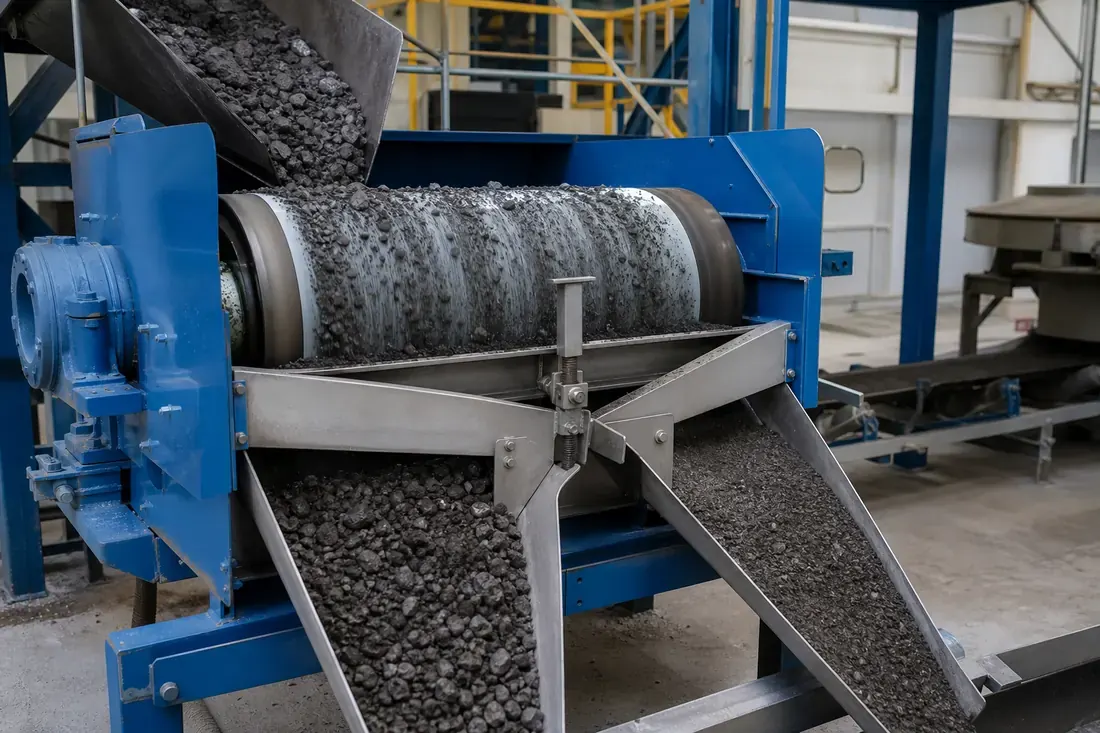
First Define the Separation Goal
- Crusher protection: remove large tramp iron before size reduction.
- Ferrous recovery: collect liberated steel or iron as a saleable or reusable fraction.
- Product cleanup: reduce responsive iron remaining in a non-metallic fraction.
These goals may require different positions and magnetic field characteristics. A machine selected to catch large tramp pieces is not automatically suitable for fine mineral cleanup.
Liberation Comes Before Recovery
If metal remains locked inside a large slag piece, the magnet must attract the combined mass and may not separate it. Crushing and screening can expose metal, but also create fines and increase equipment wear. Record whether the feed is raw slag, crushed slag, screened fraction, or a tailing from an earlier recovery stage.
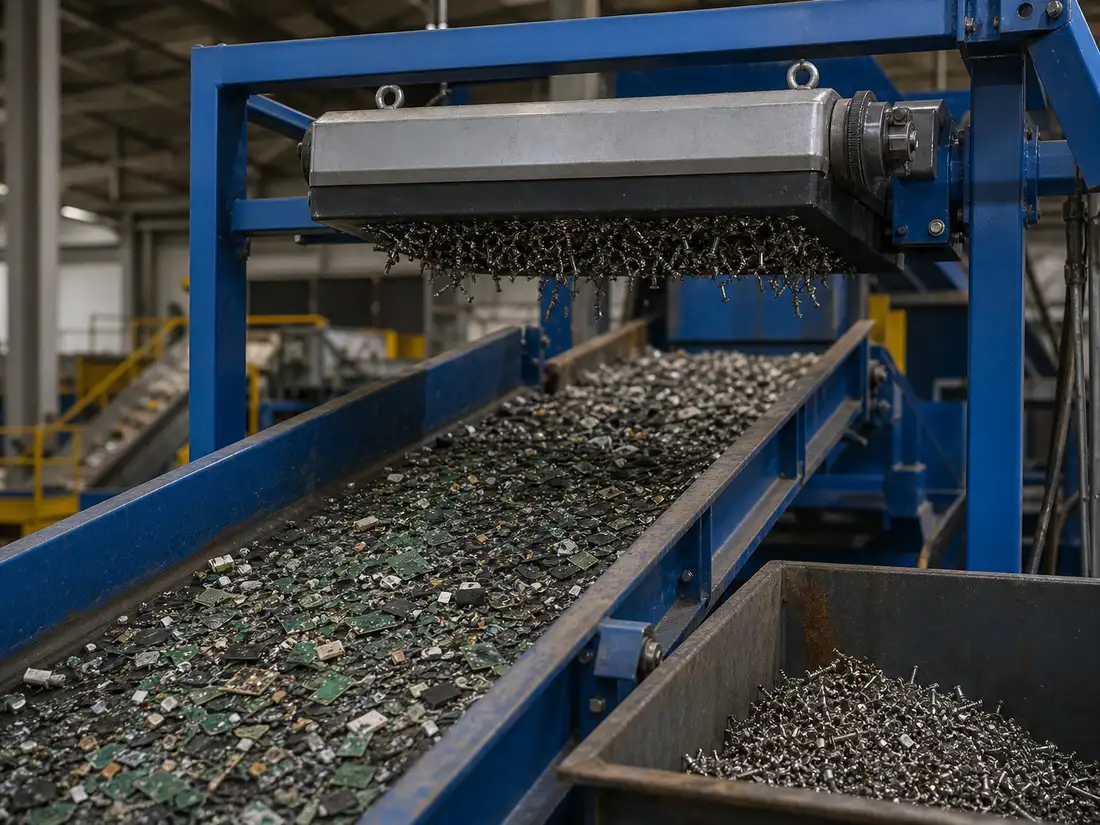
Choose the Process Position
| Need | First structure to review | Key condition |
|---|---|---|
| Protect crusher from large steel | Suspended magnet | Burden depth, belt speed, iron size, suspension height |
| Recover ferrous at belt discharge | Magnetic head pulley | Thin feed, trajectory, pulley dimensions, magnetic arc |
| Controlled separation after screening | Housed magnetic drum | Feed distribution, drum speed, splitter, wear, enclosure |
Temperature Is a Selection Boundary
Do not feed hot slag to a standard magnetic separator without confirming the actual continuous and peak material temperature, heat transfer to the magnet, belt, bearings, seals, and structure. Permanent magnet performance and non-magnetic covers can be temperature-dependent. “The slag has cooled” must be replaced by a measured range.
Abrasion, Impact, and Dust
Slag can be abrasive, angular, and dense. Review impact zones, replaceable wear parts, shell or belt protection, bearing sealing, dust control, and maintenance access. Increasing wear-liner thickness may increase the magnetic working distance, so protection and capture must be balanced.
How to Run a Useful Material Test
- Take a representative sample across normal operating periods.
- Record particle-size distribution, moisture, temperature, bulk density, and feed origin.
- Define the target fraction and analytical method.
- Test at documented feed rate, layer depth, speed, gap, and splitter setting.
- Weigh and analyze feed, magnetic product, and non-magnetic product.
- Repeat the test to determine variability.
Visual attraction of a few pieces is not a recovery test. Commercial claims require mass balance and an agreed analytical method.
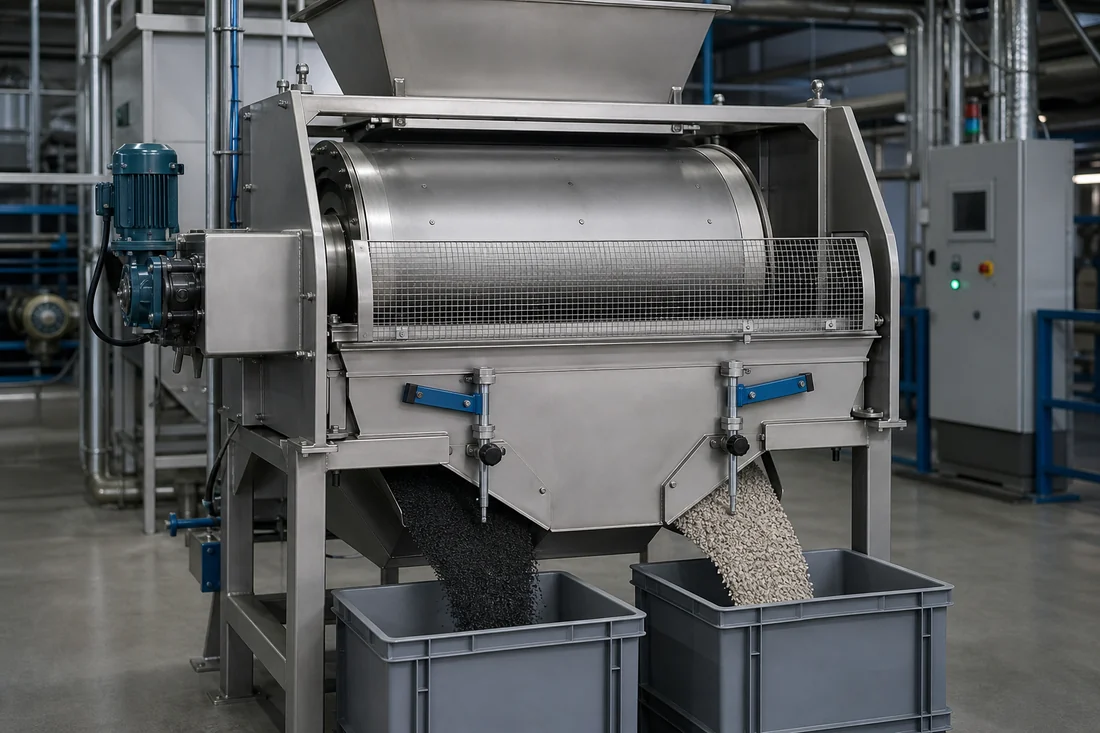
When OSENC’s Current Product Range May Not Fit
Weakly magnetic mineral recovery, high-gradient separation, wet beneficiation, and tightly specified metallurgical upgrading may require technology outside OSENC’s currently verified product range. The application review should state this clearly rather than forcing the project into a permanent drum or suspended magnet.
Information Required
Send slag source and process, whether it is fully cooled, temperature range, particle-size distribution, capacity, bulk density, moisture, existing crushing/screening stages, target metal analysis, photographs, sample availability, required products, and acceptance method.
Define the Slag Separation Duty Before Choosing a Magnet
Use these inputs to decide whether the proposed separator and process position fit the real operating duty.
| Equipment direction | First decide whether the duty is removal of damaging tramp steel or recovery of a valuable ferrous fraction; those objectives can require different field depth, feed preparation and separation stages. |
|---|---|
| Material condition | Specify slag source, cooling condition, temperature, minimum and maximum particle size, bulk density, moisture, abrasion, dust and whether metal remains locked inside larger pieces. |
| Target iron or magnetic fraction | Describe free steel, iron-rich particles and composite slag-metal pieces by size, magnetic response and desired product specification; include allowable nonferrous or slag carryover. |
| Throughput and presentation | State normal and peak throughput, feed-width distribution, layer depth, drum or belt speed and whether crushing or screening changes liberation before separation. |
| Installation and access | Confirm the installation position, inlet and outlet directions, available equipment and splitter space, heat and abrasion protection, liner thickness, feeder arrangement, dust control, guarding and access for shell, bearings and wear-part replacement. |
| Test or acceptance | Use a representative composite sample and record feed, magnetic fraction and nonmagnetic fraction by mass and composition. One hand-picked steel test does not validate recovery from slag. |
How We Configure a Solution for Your Process
Magnetic Separation for Ferrous Recovery from Slag: seller-side application review
- Your process problem: Ferrous contamination can damage downstream equipment, reduce product consistency, create rejects or force unplanned cleaning and downtime.
- What we review: We confirm your material form, particle size, moisture, temperature, bulk density, normal and peak throughput, contaminant type and size, required residual and process position.
- What we configure: We compare capture point, magnetic structure, working distance, material presentation, cleaning method and line interface before we prepare a proposal.
- Buyer value: This helps you intercept contamination before a critical machine or quality stage, reduce repeat purchases and avoid a separator that restricts normal production flow.
- Boundary: We do not recommend the application when the target is non-magnetic, the material path prevents exposure or the required result cannot be supported without testing.
- Next step: Send the material and target, particle range, moisture, temperature, throughput, contamination, installation drawing, available space, cleaning preference and any sample or site video. Send your process and contamination data
Project Support
Send your material and process conditions
We can review the process point, material shape, iron source, capacity, available space and cleaning method before recommending a magnetic separator layout.
Frequently Asked Questions
Why is “First Define the Separation Goal” important for this decision?
These goals may require different positions and magnetic field characteristics. A machine selected to catch large tramp pieces is not automatically suitable for fine mineral cleanup.
Why is “Liberation Comes Before Recovery” important for this decision?
If metal remains locked inside a large slag piece, the magnet must attract the combined mass and may not separate it.
Why is “Temperature Is a Selection Boundary” important for this decision?
Do not feed hot slag to a standard magnetic separator without confirming the actual continuous and peak material temperature, heat transfer to the magnet, belt, bearings, seals, and structure.