
OSENC Magnetic Separation
Easy-Clean Magnetic Grate for Frequently Cleaned Powder and Granule Lines
Faster Release of Captured Ferrous Contamination
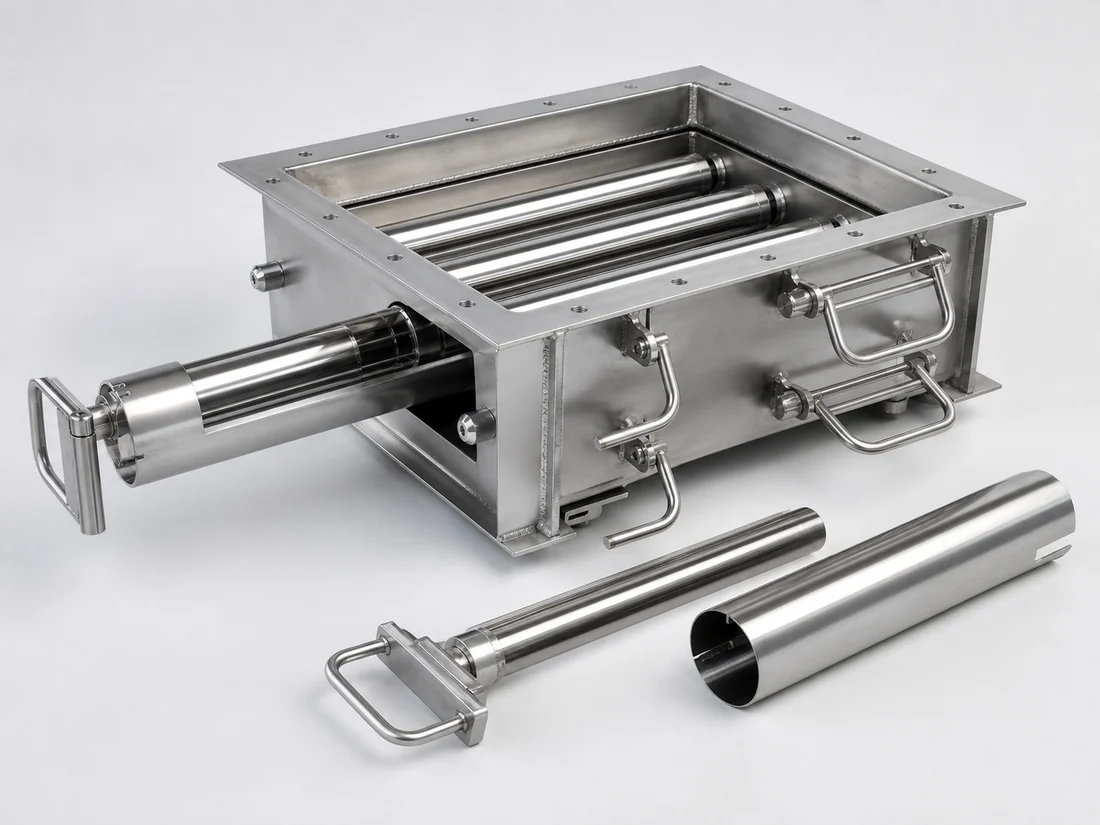
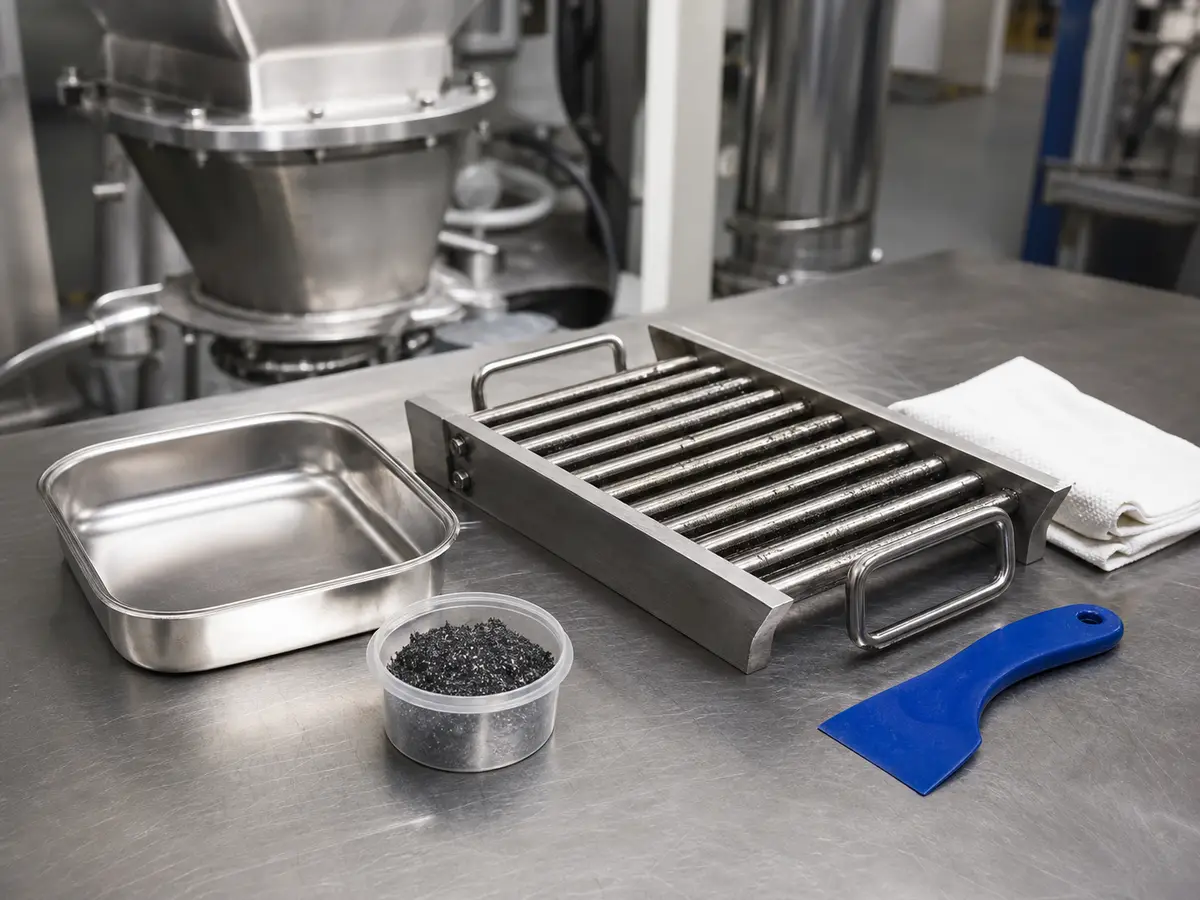
An easy-clean magnetic grate uses removable magnetic cores and collection sleeves so captured ferrous material can be released without repeatedly scraping a standard magnetic tube surface. It is most useful when cleaning is frequent, material flows freely, and the site provides enough space to remove the grate and withdraw the magnetic cores safely.
Send Your Opening and Cleaning Details Compare a Drawer Magnet
When an Easy-Clean Grate Is Worth Considering
- Typical material
- Dry, free-flowing powder and granules with responsive ferrous contamination.
- Main reason to choose
- Standard tubes require frequent scraping or cleaning takes too much operator time.
- Main trade-off
- More parts, a larger operating envelope, sleeve wear, and a higher need for correct handling.
- Required site condition
- Enough space to remove the assembly and fully withdraw its magnetic cores.
- Review carefully
- Sticky buildup, large granules, impact, bridging, hot material, sanitary requirements, and trapped wire.
How the Easy-Clean Mechanism Works
- During production, magnetic cores remain inside protective collection sleeves.
- Material passes around the sleeve arrangement and responsive iron collects near magnetic pole zones.
- Material flow is stopped and the grate is moved to a controlled cleaning position.
- The magnetic cores are withdrawn from the collection area.
- With the magnetic holding force greatly reduced at the sleeves, collected iron falls or can be removed into a tray.
- The sleeves, mechanism, and seals are inspected before the cores return to the operating position.
Sticky product, long wire, or mechanically trapped pieces may not release by gravity. Easy-clean describes the release structure; it does not automatically mean fully automatic cleaning.
Standard Magnetic Grate vs Easy-Clean Magnetic Grate
| Decision | Standard grate | Easy-clean grate |
|---|---|---|
| Iron removal | Wipe or scrape magnetic tube surfaces | Withdraw cores and release contamination from sleeves |
| Construction | Simpler, with fewer moving parts | Magnetic core, outer sleeve, guide, and handling mechanism |
| Cleaning labor | Can increase with heavy buildup | Can reduce manual scraping when correctly used |
| Space | Space to remove the grate | Space to remove the grate and withdraw cores |
| Flow area | Depends on tube diameter and spacing | Outer sleeves may require a larger diameter or different spacing |
| Best reason to choose | Cleaning is occasional and simplicity is preferred | Recorded cleaning frequency justifies the more complex mechanism |
Information Required for a Custom Drawing
- Round, square, or rectangular opening and mounting details
- Material name, particle size, bulk density, moisture, and flow behavior
- Normal and peak capacity with feeding method
- Target contamination, size, shape, and expected buildup
- Current cleaning interval and preferred iron collection method
- Available grate-removal and magnetic-core withdrawal space
- Product-contact material, surface finish, temperature, and seal requirements
- Required magnetic test method, material records, and inspection documents
Core, Sleeve, and Magnetic Field Specification
The drawing should define the relationship between the magnetic core and the outer collection sleeve, including sleeve material and thickness, effective magnetic length, core withdrawal distance, guide structure, handles, stops, and the safe cleaning position.
Magnetic performance must state the measurement position, whether the value is taken at the outer sleeve surface, the pole location, instrument, temperature, and tolerance. Adding an outer sleeve changes the distance between the magnetic core and the material, so a value measured on an uncovered magnetic tube cannot automatically be applied to an easy-clean assembly.
Flow, Tube Spacing, and Bridging
Closer spacing increases contact opportunities but reduces open area. Outer sleeves may further change the available passage. Large granules, cohesive powder, moisture, or high instantaneous feed can create a bridge above the first row.
The layout should balance magnetic contact, capacity, pressure loss, blockage risk, cleaning access, and mechanical strength. More rows are not automatically better.
Use Cleaning Frequency as a Selection Input
During commissioning, inspect the collected contamination after short, recorded operating intervals. Clean before buildup covers effective collection areas or restricts material flow. These records help determine whether an easy-clean design provides a real operating advantage and whether the tube arrangement is suitable.
Any labor-saving comparison should use the same material, contamination level, grate size, cleaning endpoint, and timed procedure.
Materials and Food-Contact Boundary
Product-contact stainless grade, sleeve thickness, welds, surface roughness, seals, handles, internal magnet grade, and working temperature must be confirmed for the specific project. An easy-clean mechanism does not automatically make the product sanitary, FDA approved, corrosion-proof, or suitable for pharmaceutical use.
Where regulated contact is required, identify the material certificate, surface-finish acceptance, cleaning method, seal material, and declaration expected by the buyer.
Safe Cleaning and Maintenance
- Stop and isolate material flow before removing the grate.
- Move the grate to the defined cleaning location and position a collection tray.
- Withdraw the magnetic cores using the designed handles and guides.
- Keep loose steel tools, watches, and pinch-sensitive items away from the magnetic assembly.
- Remove released iron and any trapped material.
- Inspect sleeves for dents, wear, product buildup, and damaged seals.
- Return the cores fully to the operating stops before restarting the process.
When a Drawer Magnet May Be Better
Choose a drawer magnet for review when the line needs an enclosed housing, fixed inlet and outlet, guided pull-out access, or better dust containment. An open easy-clean grate does not replace a pressure-rated or sealed housing.
Inspection and Acceptance
Inspection may cover frame dimensions, tube or sleeve spacing, core travel, stops and guides, surface finish, weld condition, material records, and magnetic measurements at defined outer-sleeve positions. The quotation should identify which records are provided by OSENC, a manufacturing partner, or a third-party laboratory.
Request an Easy-Clean Magnetic Grate Review
Send the opening drawing, material, particle size, capacity, temperature, current cleaning interval, target iron, available withdrawal space, and required documents. OSENC will confirm the feasible mechanism and the specifications that still require validation.
Easy-Clean Grate Selection Inputs
The quotation should describe powder or granules requiring frequent manual cleaning and connect each proposed feature to an operating or acceptance requirement.
| Selection logic | Choose an easy-clean design when cleaning frequency and safe contaminant release justify the added sleeve gap and withdrawal mechanism. |
|---|---|
| Application inputs | Material flowability, particle sizes, bulk density, moisture, contamination loading, temperature and required cleaning interval |
| Mechanical interface | Opening, row arrangement, core and sleeve construction, extraction direction, seal, collection tray and full pull-out space |
| Cleaning and service | Document isolation, core withdrawal, iron collection, sleeve inspection and reassembly so released contamination cannot return to product. |
| Acceptance method | Compare magnetic performance at the collection surface, not only at the internal core, and verify dimensions and cleaning operation. |
Project Scope and Supply Boundary
Boundary for Easy-Clean Magnetic Grate for Frequently Cleaned Powder and Granule Lines
- This is a configurable project page, not a released standard model with universal published performance.
- We confirm the manufacturing route, approved drawing and opening and interface, tube layout, contact materials, shell or sleeve construction, extraction space, cleaning method and flow behaviour for the inquiry.
- Dimensions, magnetic values, pull force, capacity, separation result, materials, certification, lead time and warranty become project facts only in traceable quotation, drawing, inspection or order documents.
Safety Boundary Before Installation, Cleaning or Maintenance
- Stop and isolate product flow, pressure, actuators and connected machinery before withdrawing or cleaning magnetic elements. The magnetic field remains active outside the process. Prevent hand trapping between magnetic parts and steel, control attracted tools and sharp captured fragments, and contain removed contamination so that it cannot return to product.
- People with pacemakers or magnetically sensitive medical devices must follow medical-device and site restrictions; protect sensitive electronics and magnetic media.
- Our guidance is not a complete safe-work procedure. Approved manufacturer instructions, the site risk assessment, guarding and lifting plans, and lockout/tagout rules govern the work.
Combustible Dust and Hazardous-Area Boundary
- For the powder or granular product, the plant owner must identify any combustible dust, vapour or gas and provide the site hazardous-area classification.
- No-coil permanent equipment is not automatically suitable: assess impact, friction, static, hot surfaces, bearings, drives, sensors and controls in the complete configuration.
- Confirm zone or division, substance and ignition data, dust layers, temperatures, earthing and bonding, cable entries, ingress protection, cleaning and destination-country rules.
- Do not claim explosion-proof or ATEX suitability until configuration-specific marking, declaration, instructions and evidence are verified.
Engineering Conditions Behind the Recommendation
- A high surface reading does not by itself predict capture in flowing product.
- Field gradient, shell or sleeve thickness, spacing, distance from each particle to a pole, particle size and magnetic response, flow speed, product depth, bridging and contamination buildup all change the result.
- Mechanical passage capacity is not the same as effective separation capacity.
- Quote or test conditions must identify material, size distribution, moisture, bulk density, normal and peak rate, feed distribution, speed, layer or flow geometry, contamination loading and cleaning interval.
Project Support
Send your drawing, material data or installation photo
We will review the product structure, magnetic circuit direction, cleaning method, material contact requirements and inspection items before preparing a quotation.
Frequently Asked Questions
How the Easy-Clean Mechanism Works?
Sticky product, long wire, or mechanically trapped pieces may not release by gravity. Easy-clean describes the release structure; it does not automatically mean fully automatic cleaning.
Why is “Core, Sleeve, and Magnetic Field Specification” important for this decision?
The drawing should define the relationship between the magnetic core and the outer collection sleeve, including sleeve material and thickness, effective magnetic length, core withdrawal distance, guide structure, handles, stops, and the safe cleaning position.
Why is “Flow, Tube Spacing, and Bridging” important for this decision?
Closer spacing increases contact opportunities but reduces open area. Outer sleeves may further change the available passage.