
Separação magnética OSENC
The main magnetic separator types are suspended magnets, self-cleaning overband magnets, magnetic head pulleys, housed magnetic drums, magnetic tubes, magnetic grates, easy-clean grates and drawer magnets. The correct type depends first on how the material moves, where the iron is located, the working distance and how captured metal must be discharged—not on the highest advertised Gauss value.
Submit an application when the separator type is not yet decided
Quick Type Comparison
| Separator | Typical position | Melhor aplicação inicial | Main limitation |
|---|---|---|---|
| Permanent suspended magnet | Above conveyor | Occasional tramp iron | Requires planned manual cleaning |
| Self-cleaning overband magnet | Above conveyor | Frequent iron and continuous discharge | Needs drive, belt tracking and discharge space |
| Polia magnética de cabeça | Conveyor discharge | Continuous separation at belt trajectory | Must match pulley loads and conveyor geometry |
| Housed magnetic drum | Free-fall feed | Continuous enclosed separation | Requires controlled feed and splitter setting |
| Magnetic tube | Chute, hopper or OEM unit | Point capture and custom arrangements | Performance is local to the tube field |
| Magnetic grate | Gravity powder opening | Fine ferrous contamination in free-flowing material | Tight spacing can cause bridging |
| Easy-clean magnetic grate | Frequently cleaned gravity line | Faster release of collected iron | Outer sleeve increases the working gap |
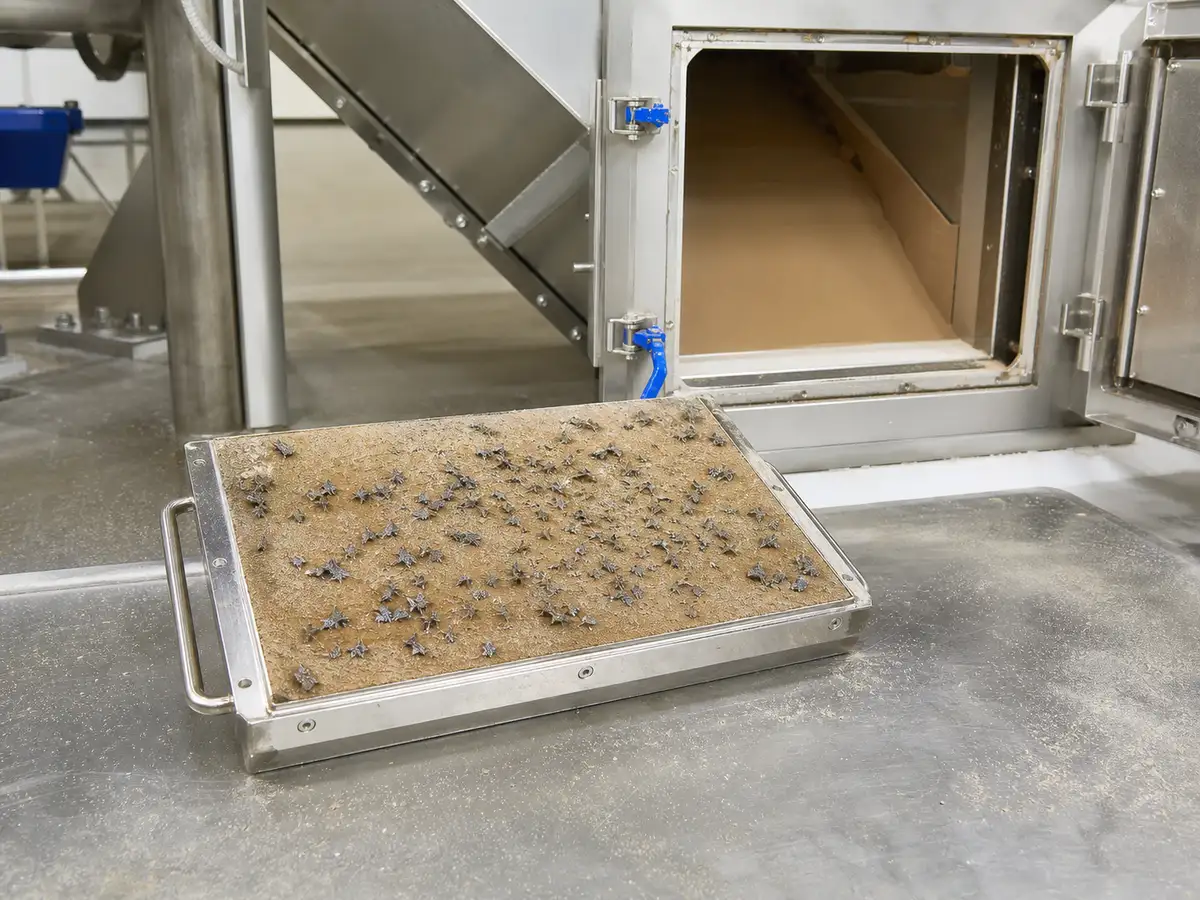
| Drawer magnet | Enclosed gravity line | Multiple tube rows with pull-out access | Needs side clearance and suitable flow behavior |
For Material on a Conveyor
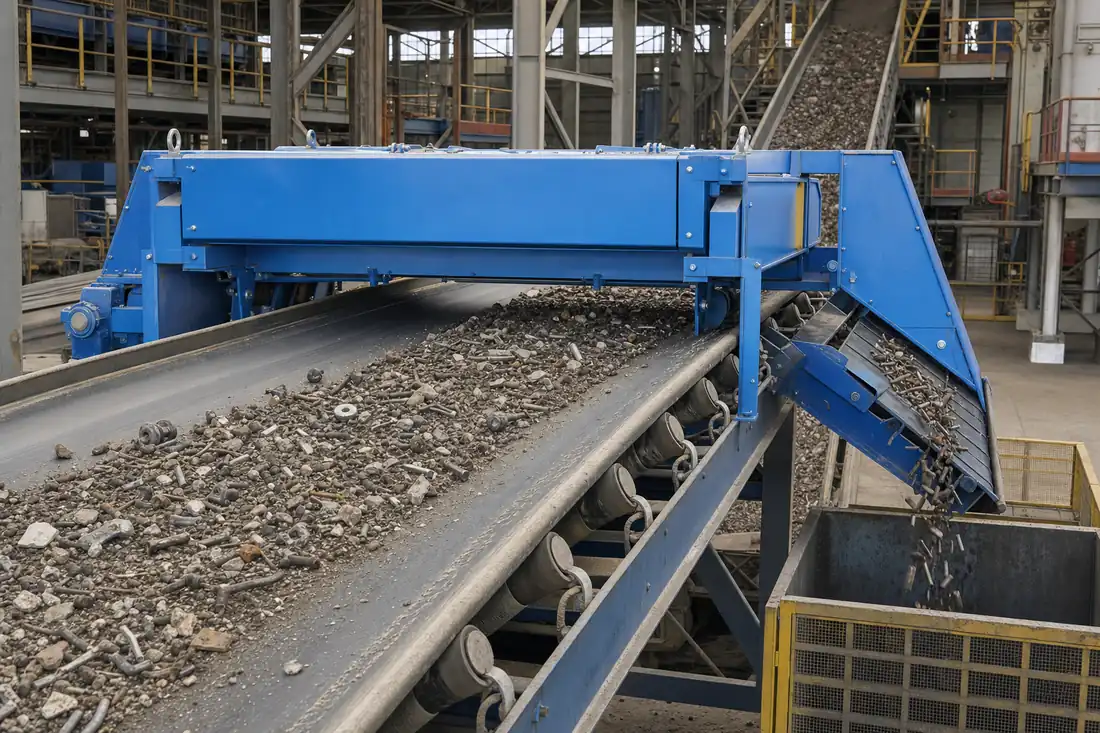
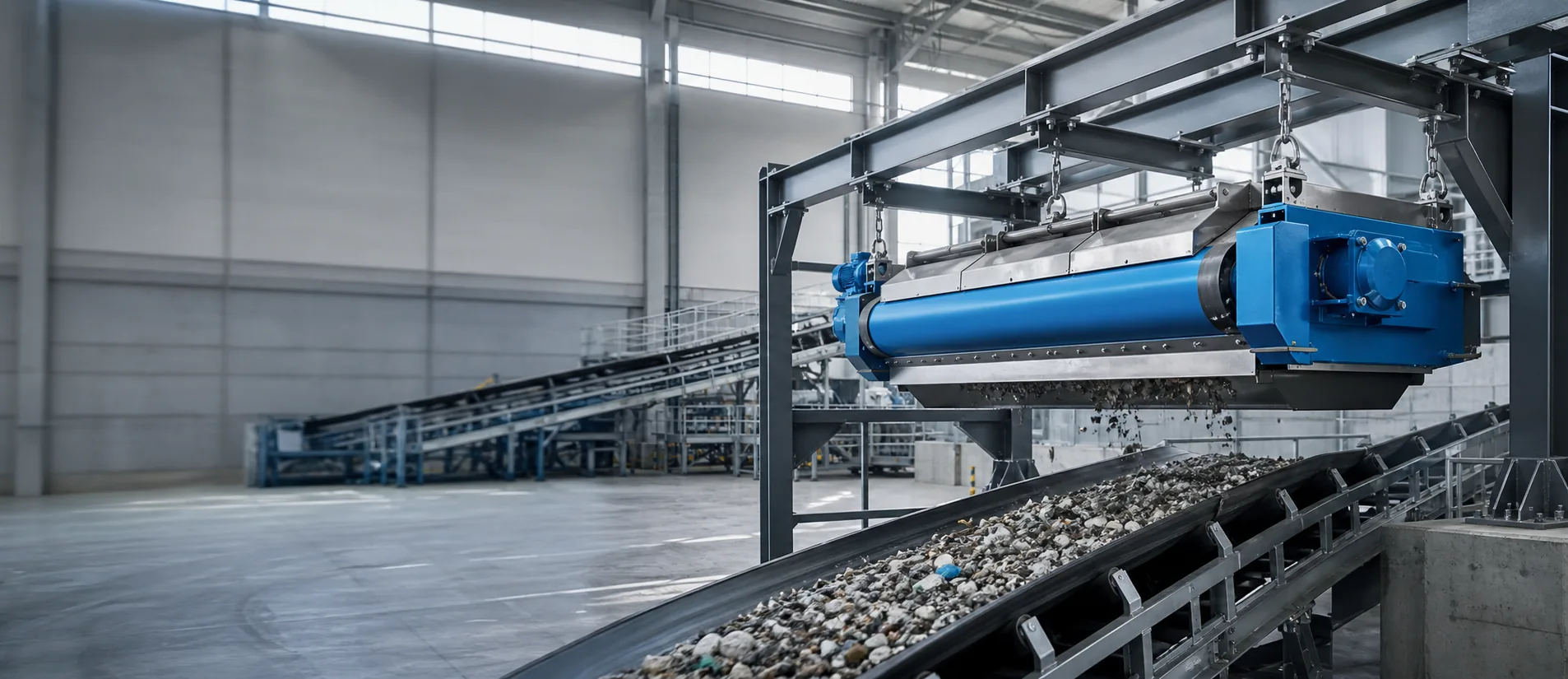
Use a suspended magnet when the separation point is above the burden. A manual-clean permanent unit may suit low tramp-iron frequency; a self-cleaning overband adds a driven cleaning belt for continuous discharge. Selection requires belt width, burden depth, belt speed, target iron, bulk density, suspension height and installation position.
Use a magnetic head pulley when separation can occur at the conveyor discharge. The ferrous fraction remains attracted around the pulley while non-magnetic material follows its normal trajectory. This requires a suitable splitter and confirmed pulley diameter, face width, shaft, loads, belt speed and magnetic arc.
For Free-Falling Bulk Material
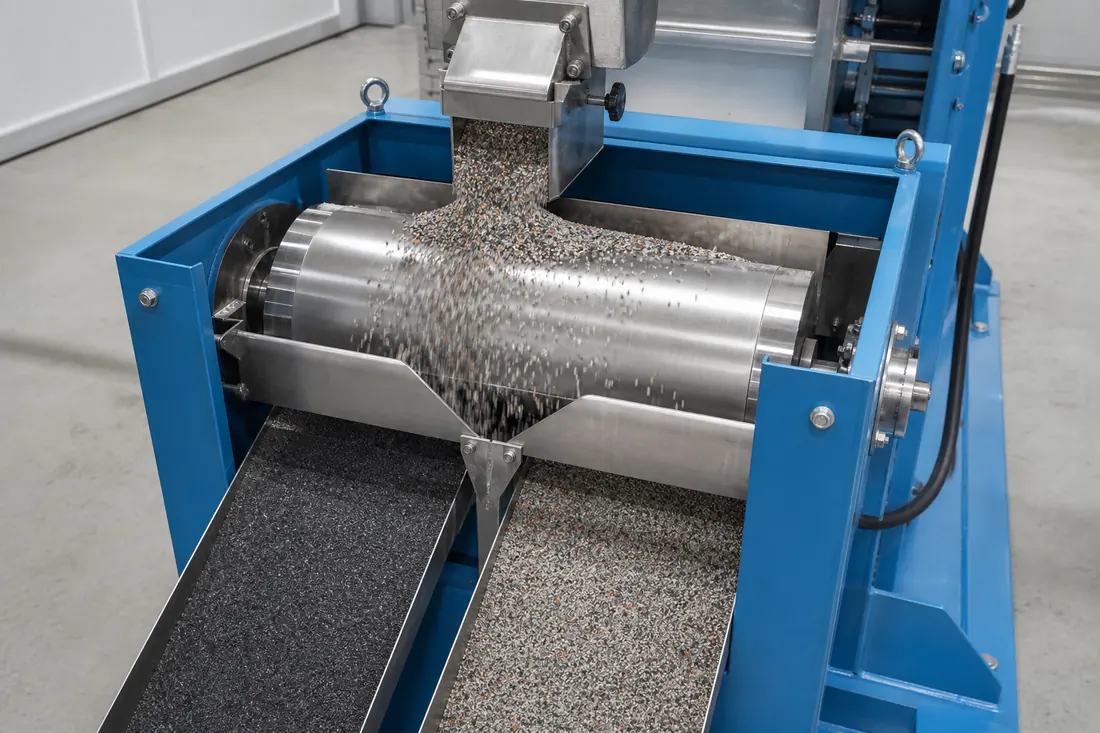
A housed drum receives material through an inlet, presents it to a rotating magnetic shell and divides the trajectories into magnetic and non-magnetic outlets. Feed distribution, particle size, moisture, bulk density, drum speed and splitter position determine whether a nominal capacity is meaningful.
For fine powder or granules, tubes and grates place the material close to magnetic poles. They work best when the material is free-flowing and distributed across the magnetic surfaces. Sticky material, product buildup and large lumps can prevent contact or block the opening.
Permanent, Rare-Earth and Electromagnetic Systems
Permanent describes how the magnetic field is generated; ferrite and rare-earth describe magnet-material families. Electromagnets use electrical excitation and create additional questions about power, cooling, insulation, temperature rise and controls. OSENC does not currently list electromagnetic overband separators as a confirmed launch product.
Compare ferrite and rare-earth magnetic circuits Compare permanent and electromagnetic separators
Five Inputs That Usually Decide the Type
- Material path: conveyor, discharge trajectory, free fall or enclosed gravity line.
- Target: large tramp iron, liberated ferrous pieces or fine contamination.
- Working distance: burden depth, air gap, tube sleeve or other separation distance.
- Cleaning duty: manual, intermittent or continuous discharge.
- Process constraint: capacity, flowability, pressure, abrasion, temperature, hygiene and hazardous area.
When Ordinary Magnetic Separation Is Not the Answer
Ordinary permanent separators do not remove aluminum or copper, sort plastic by polymer, or guarantee recovery of weakly magnetic minerals and some stainless steels. If the target is uncertain, identify the contaminant and run representative tests before selecting equipment.
Check target-metal behavior Planejar testes com material representativo Review OSENC product families
Match Separator Type to Material Path
| Critério de decisão | Select by how material moves and where the target can approach the magnetic field: contact devices suit chutes and pipes, suspended units suit conveyors, and drums or pulleys suit continuous separation at discharge. |
|---|---|
| Dados a confirmar | Dry or wet state, powder, granule, lump or slurry form, particle size, bulk density, moisture, target type, throughput, layer depth and available process position. |
| Risco ou limitação | Equipment names are not interchangeable; a high surface field on a tube does not solve a deep conveyor burden, and an overband does not create the close-contact gradient of a grate. |
| Ação do comprador | Sketch the process path and shortlist only devices that can physically present the target at a workable distance before comparing magnetic values. |
Como Aplicamos Este Aspecto Técnico à Seleção
Types of Magnetic Separators: Choose by Material Flow and Separation Point: seller-side application review
- Seu risco de seleção: A designação do equipamento, um valor de Gauss na superfície ou o resultado de um ensaio estático de força de atração podem levar a uma compra inadequada quando o movimento do material e a distância de trabalho são ignorados.
- O que analisamos: Verificamos seu material, a granulometria, a umidade, a temperatura, a vazão ou capacidade de processamento, a geometria da camada ou do fluxo, o contaminante-alvo, a posição de instalação e o método de limpeza.
- O que decidimos: Usamos o princípio descrito acima para comparar o circuito magnético, a exposição, a retenção e as condições de descarga antes de recomendar ou descartar uma configuração.
- Benefício para o comprador: Isso ajuda a reduzir o risco de passagem de contaminantes, evitar uma unidade superdimensionada ou ineficaz e relacionar a especificação a um objetivo de produção testável.
- Limite: Não consideramos uma explicação simplificada como garantia de desempenho de separação; são necessários ensaios representativos quando a resposta magnética ou a ampliação de escala ainda forem incertas.
- Próxima etapa: Envie o material e o objetivo da separação, a faixa granulométrica, a umidade, a temperatura, a capacidade de processamento, a contaminação, o desenho de instalação, o espaço disponível, a preferência de limpeza e qualquer amostra ou vídeo da instalação. Enviar o material e o objetivo da separação
Suporte ao projeto
Precisa de ajuda para selecionar a solução magnética adequada?
Envie o material, as condições de fluxo, o metal-alvo, a capacidade de processamento, o espaço de instalação e quaisquer desenhos ou fotos da instalação. Analisaremos a aplicação e recomendaremos a próxima etapa prática.
Perguntas frequentes
Why is “For Material on a Conveyor” important for this decision?
Use a suspended magnet when the separation point is above the burden. A manual-clean permanent unit may suit low tramp-iron frequency; a self-cleaning overband adds a driven cleaning belt for continuous discharge.
Why is “For Free-Falling Bulk Material” important for this decision?
A housed drum receives material through an inlet, presents it to a rotating magnetic shell and divides the trajectories into magnetic and non-magnetic outlets.
Why is “Permanent, Rare-Earth and Electromagnetic Systems” important for this decision?
Permanent describes how the magnetic field is generated; ferrite and rare-earth describe magnet-material families. Electromagnets use electrical excitation and create additional questions about power, cooling, insulation, temperature rise and controls.