
Separação magnética OSENC
Self-Cleaning Permanent Overband Magnet
Continuous Automatic Iron Discharge
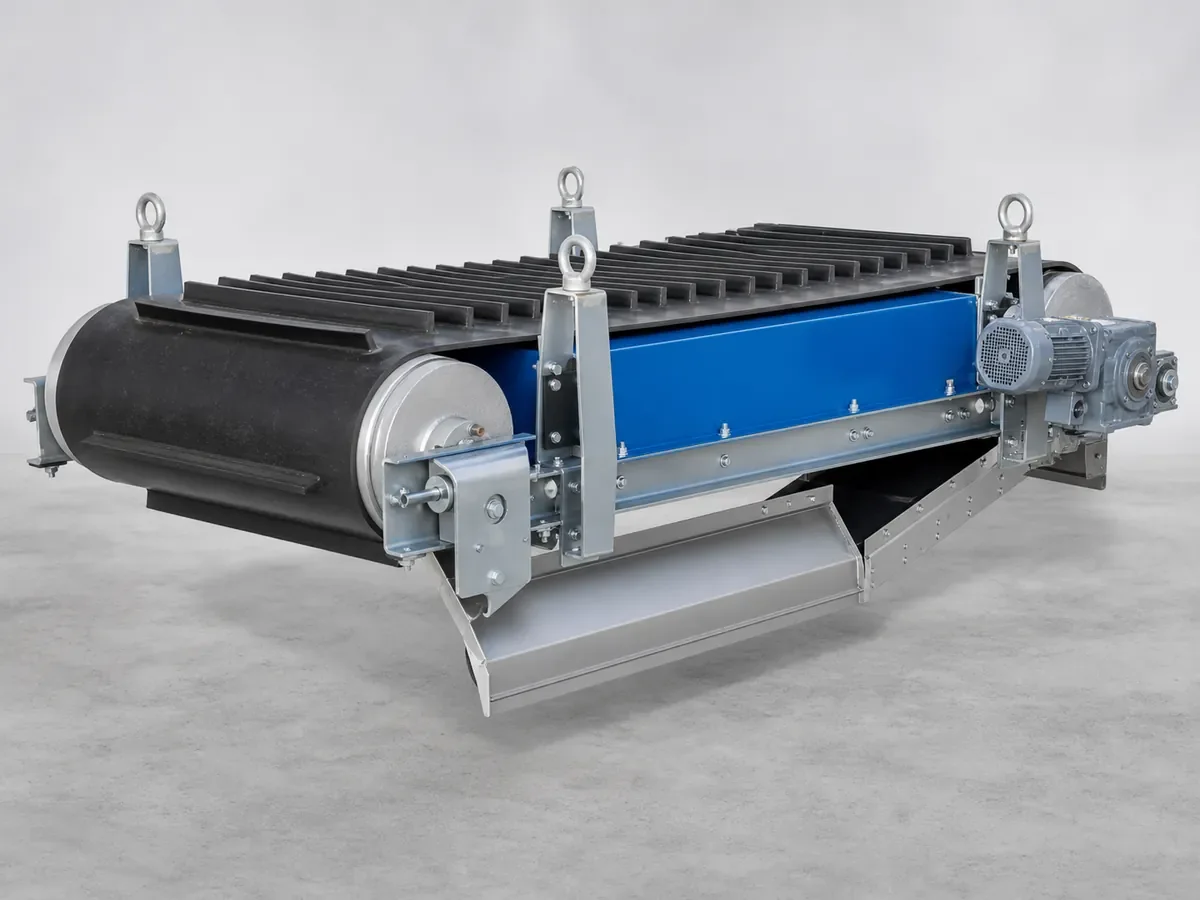
A self-cleaning permanent overband magnet combines a permanent suspended magnetic circuit with a short motor-driven cleaning belt. It is reviewed when tramp iron arrives frequently, the main conveyor operates continuously, or manual cleaning would cause excessive shutdown or unsafe buildup.
Send Conveyor and Discharge Layout Compare Manual-Clean Suspended Magnet
Magnetic Power and Motor Power Are Different
The permanent magnetic circuit requires no excitation power. The motor drives the cleaning belt that carries captured iron out of the active field. A specification must list cleaning motor/reducer data separately and must not describe that value as magnetic excitation power.
Choose Crossbelt or Inline
| Layout | Typical use | Check |
|---|---|---|
| Crossbelt | Cleaning belt discharges to the side of the main conveyor | Side clearance, support, iron collection, trough geometry |
| Inline | Cleaning belt generally follows the main material direction near discharge | Head-pulley trajectory, splitter, longitudinal space |
The final choice must preserve rated working height and ensure the largest captured piece clears the main belt, guards, and structure.
Selection Inputs
- Main belt width, trough angle, speed, and material burden
- Target iron size, shape, amount, and frequency
- Magnet face-to-belt and face-to-burden references
- Available width, length, height, lifting, and maintenance space
- Discharge direction and collection-bin position
- Ambient/material temperature, dust, rain, corrosion, and impact
- Site voltage, control scope, and operating hours
Cleaning-Belt and Drive Data
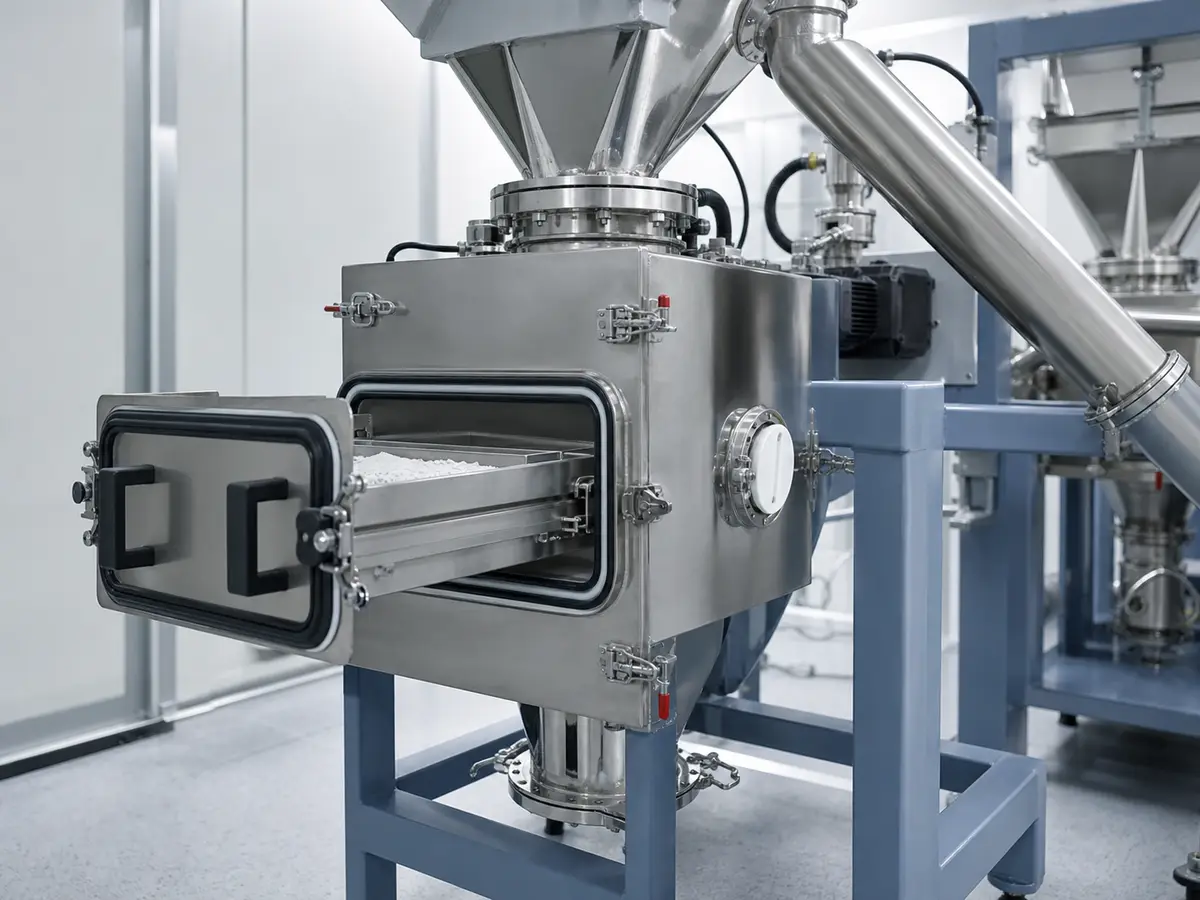
The approved project should define belt width, material, cleats or reinforcement where applicable, pulley/roller arrangement, take-up, tracking adjustment, bearings, motor, reducer, guards, rotation, and spare-parts scope. Weather cover, belt-misalignment switch, speed monitoring, or control cabinet must be quoted only when confirmed.
Standard Configuration Range
| Item | Standard offering |
|---|---|
| Main conveyor belt width | 500–1,600 mm |
| Rated magnet-face-to-belt distance | 150–450 mm |
| Main conveyor speed | Up to 3.5 m/s |
| Cleaning belt width | 650–1,800 mm |
| Cleaning belt speed | 1.5–2.5 m/s |
| Drive power | 1.5–7.5 kW according to frame and belt size |
| Standard electrical supply | 380 V, 50 Hz, three-phase; destination supply available by order |
| Motor protection | IP55 standard |
| Discharge layout | Crossbelt left/right discharge or inline discharge |
| Normal material temperature | Up to 80°C |
Commissioning
- Check frame condition, suspension, guards, fasteners, and clearance.
- Jog the drive and confirm rotation before continuous running.
- Track and tension the cleaning belt under the product manual.
- Run without feed and inspect noise, vibration, bearings, and discharge.
- Introduce material gradually and verify iron clears the main stream.
- Record installed height, burden, speed, and representative test results.
Common Failure Causes
- Magnet installed above its rated working height
- Insufficient clearance for captured iron
- Cleaning belt running or tracking incorrectly
- Iron discharge returning to the product stream
- Deep surges hiding iron below the useful field
- Sharp or hot iron damaging the cleaning belt
Inspection and Documentation
Project records may include approved dimensions, magnetic test at defined points/height, belt tracking, no-load trial, motor/reducer documents, photographs, packing, and maintenance guidance. Identify whether OSENC, the manufacturing partner, or a third party produces each record.
Request a Project Review
Send conveyor drawing, burden data, iron photographs/frequency, installation position, discharge direction, operating environment, power supply, control requirement, and available access.
Self-Cleaning Overband RFQ Inputs
The quotation should describe conveyor material with continuous or frequent tramp-steel removal and connect each proposed feature to an operating or acceptance requirement.
| Selection logic | Use a self-cleaning belt when iron loading, production continuity or access makes repeated manual cleaning impractical. |
|---|---|
| Application inputs | Material, particle and lump size, bulk density, moisture, belt width, speed, burden profile, target steel and expected iron loading |
| Mechanical interface | Specify crossbelt or inline orientation, discharge side, support steel, power supply, drive and belt details, guarding and bin clearance. |
| Cleaning and service | Define belt inspection, tracking and tension checks, scraper or discharge condition, bearings, gearbox and safe lockout access. |
| Acceptance method | Agree working-height capture test, belt no-load run, tracking, rotation, dimensions and the documents for supplied electrical and mechanical components. |
Project Scope and Supply Boundary
Boundary for Self-Cleaning Permanent Overband Magnet
- We supply self-cleaning permanent overband magnets in the standard configuration range described here.
- The approved drawing fixes belt width and speed, burden depth, rated suspension height, target iron, cleaning-belt structure, drive, guards, discharge direction and structural interface.
- Dimensions, magnetic values, pull force, capacity, separation result, materials, certification, lead time and warranty become project facts only in traceable quotation, drawing, inspection or order documents.
Safety Boundary Before Installation, Cleaning or Maintenance
- Before access, isolate and lock out the conveyor, separator drive and connected equipment under the site procedure; verify that movement cannot restart. A permanent magnet remains active after electrical isolation. Control suspended loads, pinch and nip points, attracted tools, loose steel, sharp collected iron and safe access around the belt and discharge zone.
- People with pacemakers or magnetically sensitive medical devices must follow medical-device and site restrictions; protect sensitive electronics and magnetic media.
- Our guidance is not a complete safe-work procedure. Approved manufacturer instructions, the site risk assessment, guarding and lifting plans, and lockout/tagout rules govern the work.
Condições de Engenharia que Fundamentam a Recomendação
- Não selecione o equipamento com base apenas no valor de Gauss na superfície.
- Analise a intensidade e o gradiente do campo na distância nominal de trabalho, considerando a correia transportadora, a altura da camada de material e qualquer placa de proteção.
- A velocidade da correia, a uniformidade da alimentação e o tamanho, o formato e a resposta magnética do material-alvo determinam o tempo e a força disponíveis para a captura.
- A capacidade mecânica de passagem não é igual à capacidade efetiva de separação.
- As condições da cotação ou do ensaio devem identificar o material, a distribuição granulométrica, a umidade, a densidade aparente, as taxas normal e de pico, a distribuição da alimentação, a velocidade, a geometria da camada ou do fluxo, a carga de contaminantes e o intervalo de limpeza.
Dados necessários para configurar este projeto
Input set for Self-Cleaning Permanent Overband Magnet
- Como usamos seus dados: Comparamos o material, o risco de contaminação, a meta de produção e a interface com a linha antes de configurar uma proposta ou descartar uma opção inadequada.
- Material: nome e composição; seco ou úmido; pó, grânulos, torrões, fibras ou polpa; distribuição granulométrica mínima, máxima e típica; umidade, pegajosidade, tendência à aglomeração ou formação de pontes, abrasividade, corrosividade, densidade aparente, temperatura normal e temperatura máxima.
- Produção e objetivo: capacidade de processamento normal e de pico, alimentação contínua ou em bateladas, uniformidade da alimentação, objetivo de remoção de contaminantes ou recuperação, resposta magnética, se conhecida, tamanho típico e máximo do material-alvo, concentração inicial, teor residual aceitável e se a perda de produto é permitida.
- Instalação: largura e velocidade da correia, profundidade normal e máxima da camada de material, posição do ímã e distância nominal de trabalho, espaço disponível para suspensão e manutenção, configuração de suporte e içamento; método de limpeza, parada permitida, requisitos de materiais em contato com o produto, desgaste e corrosão; condições em ambiente interno, externo, sujeito a lavagem, com alta umidade, empoeirado ou em área classificada.
- Arquivos de apoio ao projeto: tensão, frequência e número de fases do acionamento quando for considerada uma unidade autolimpante; interface de controle e eventual necessidade de fornecimento de ar no local; país de destino; desenhos atuais, fotografias do local, vídeo do equipamento em operação e uma amostra representativa do material/contaminante quando forem necessários testes.
- O que você receberá em seguida: Usamos os dados confirmados para preparar um desenho específico do projeto e um plano de inspeção. O desempenho somente será considerado confirmado após o projeto acordado e qualquer teste representativo ou aceitação em campo exigidos comprovarem o resultado.
Suporte ao projeto
Send your drawing, material data or installation photo
We will review the product structure, magnetic circuit direction, cleaning method, material contact requirements and inspection items before preparing a quotation.
Perguntas frequentes
Why is “Magnetic Power and Motor Power Are Different” important for this decision?
The permanent magnetic circuit requires no excitation power. The motor drives the cleaning belt that carries captured iron out of the active field.
Why is “Choose Crossbelt or Inline” important for this decision?
The final choice must preserve rated working height and ensure the largest captured piece clears the main belt, guards, and structure.
Why is “Cleaning-Belt and Drive Data” important for this decision?
The approved project should define belt width, material, cleats or reinforcement where applicable, pulley/roller arrangement, take-up, tracking adjustment, bearings, motor, reducer, guards, rotation, and spare-parts scope.