
OSENC Magnetic Separation
Dry Mineral Iron Removal: Tramp Metal or Mineral Beneficiation?
Start by separating two different goals. Removing bolts, wire, tools, and strongly magnetic iron from a dry mineral stream may fit a suspended magnet, head pulley, or drum. Upgrading weakly magnetic minerals is a beneficiation problem that may require high-intensity equipment and laboratory testing outside OSENC’s current verified range.
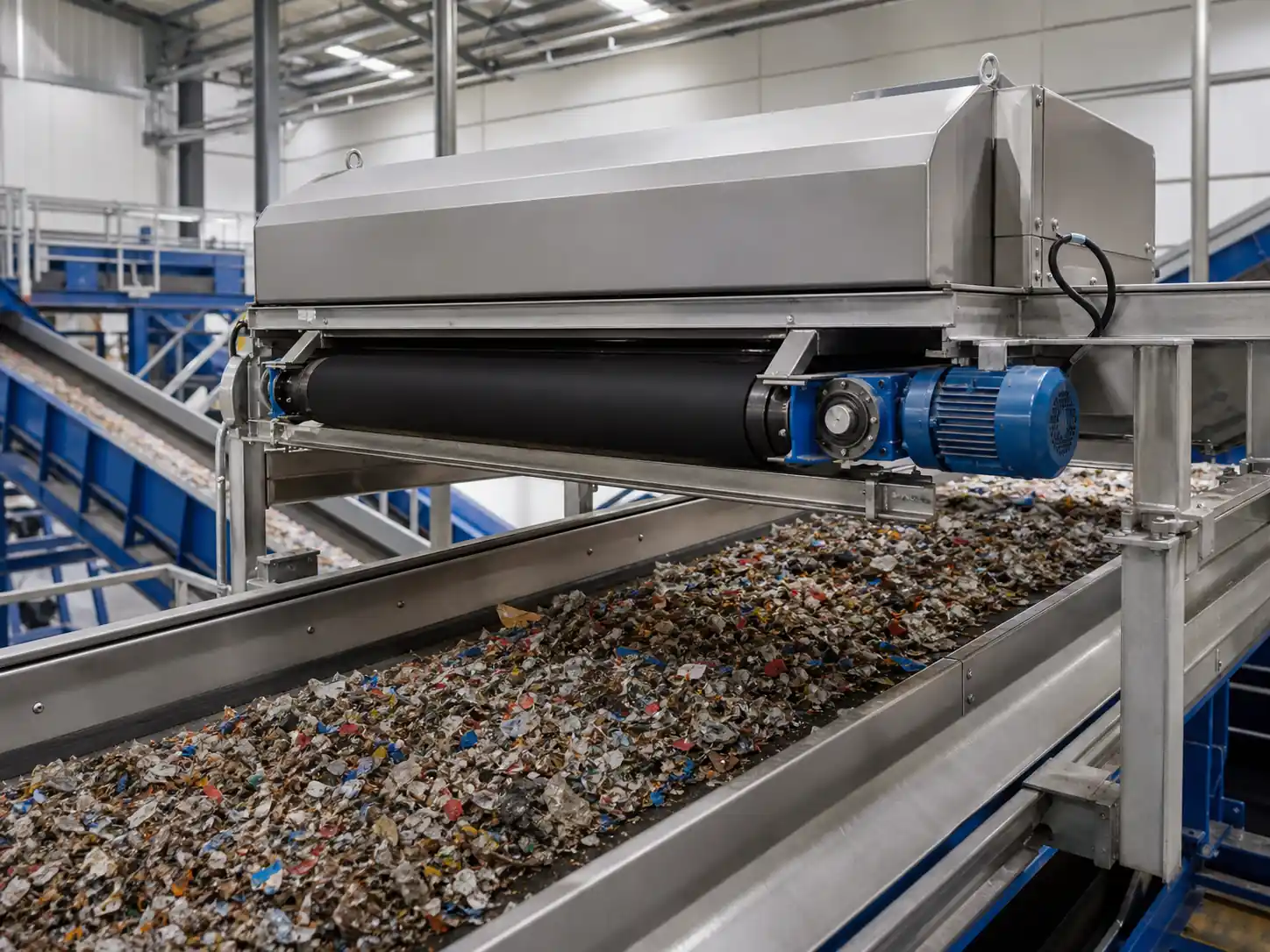
Classify the Target Before Choosing a Machine
| Target | Typical objective | First decision |
|---|---|---|
| Large manufactured iron | Protect crusher, mill, screen, or conveyor | Review suspended magnet and burden conditions |
| Liberated strongly magnetic particles | Recover or remove a ferrous fraction | Review drum/head pulley and test feed behavior |
| Weakly magnetic mineral grains | Increase grade or remove mineral impurity | Laboratory characterization and specialized technology review |
| Non-magnetic metal | Remove aluminum, copper, or non-responsive stainless | Use another separation principle |
Why “Gauss” Alone Does Not Select the Separator
Capture depends on field strength, gradient, working distance, particle magnetic susceptibility, particle mass, competing mechanical forces, and exposure time. A high surface reading at one point does not describe the useful field throughout a mineral bed. Define where the value is measured and test the actual target fraction.
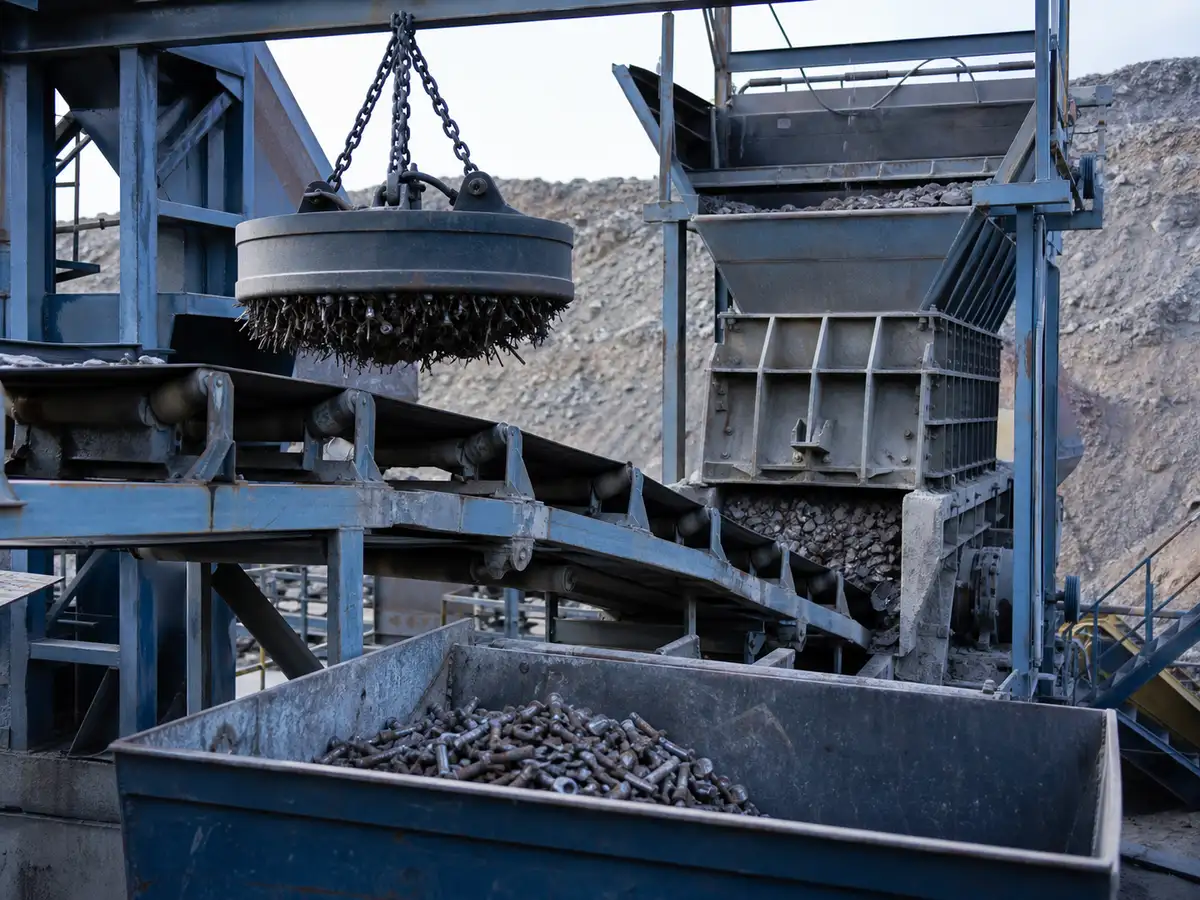
Product Positions for Strong Ferrous Removal
- Suspended magnet: for exposed tramp iron above a conveyor, particularly before vulnerable equipment.
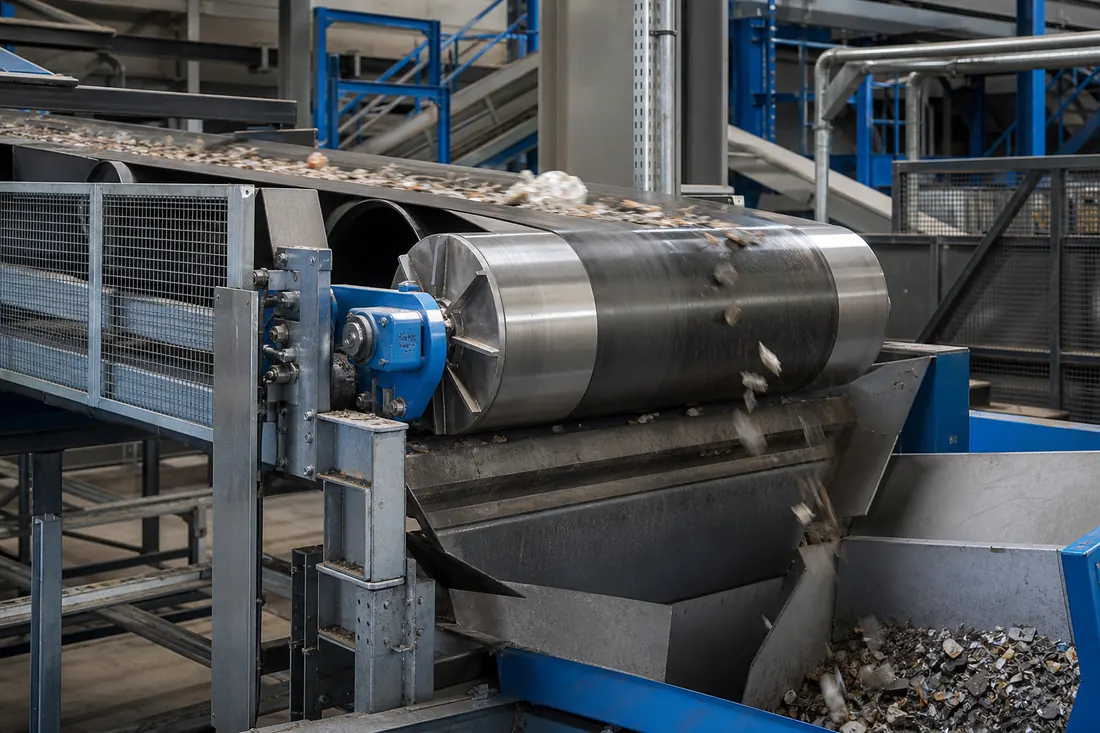
- Magnetic head pulley: for continuous separation as a thin mineral layer leaves a belt.
- Housed magnetic drum: for controlled dry feed through a defined inlet, magnetic arc, and splitter.
Dry Feed Conditions That Change Performance
- Particle size
- Wide size distributions can cause segregation and unstable trajectories.
- Moisture
- Even nominally dry minerals may cake or coat surfaces when humidity rises.
- Dust
- Requires sealing, housekeeping, and bearing/drive protection.
- Bulk density
- Changes burden depth for a given tonnage and belt geometry.
- Liberation
- Locked iron-mineral particles behave differently from exposed metal.
- Feed distribution
- A thin, uniform layer gives more consistent magnetic exposure.
Testing for a Beneficiation Objective
A useful test records feed mineralogy, particle-size distribution, moisture, mass, magnetic susceptibility where available, device settings, and analytical results for each fraction. Report grade and recovery only with a mass balance and defined analytical method. A hand-magnet response is useful screening information but not a production guarantee.
Common Errors
- Calling tramp-metal removal and mineral beneficiation the same application
- Selecting from maximum surface Gauss
- Ignoring liberation and particle-size classes
- Testing a hand-picked sample instead of representative feed
- Quoting capacity without density, feed width, layer depth, and moisture
- Assuming dry feed remains free-flowing in all seasons
Current OSENC Supply Boundary
OSENC can review custom magnetic drums, head pulleys, suspended magnets, and magnetic assemblies for strongly responsive ferrous removal. OSENC does not currently present wet drums, high-gradient mineral separators, or specialized weak-magnetic beneficiation systems as confirmed standard products.
Information OSENC Needs
Send mineral name and source, process goal, target analysis, particle-size distribution, capacity, bulk density, moisture, temperature, current process flow, photographs, sample availability, proposed installation point, and required test or product specification.
Separate Tramp-Iron Removal from Mineral Beneficiation
Use these inputs to decide whether the proposed separator and process position fit the real operating duty.
| Equipment direction | A conventional grate, suspended magnet or drum may remove ferrous contamination, but weakly magnetic mineral beneficiation can require a different high-gradient or high-intensity process that must be confirmed by testing. |
|---|---|
| Material condition | Identify the mineral, chemistry, dry moisture level, minimum and maximum particle size, fines distribution, bulk density, dust, flowability, abrasion and temperature. |
| Target iron or magnetic fraction | State whether the target is steel contamination, liberated magnetite, weakly magnetic mineral or a composite particle; provide feed grade and required concentrate or residual specification. |
| Throughput and presentation | Provide normal and peak feed rate, feeding uniformity, layer thickness, residence time and planned drum or roll speed. Beneficiation results cannot be separated from feed presentation. |
| Installation and access | Define feeder type, enclosure, dust extraction, splitter arrangement, sampling points, cleaning access and available space for staged separation or a recirculation pass. |
| Test or acceptance | Begin with a mineralogical and representative separation test. Record mass pull, grade, recovery and misplaced material under stated feed and machine settings. |
Combustible Dust and Hazardous-Area Boundary
- For the named dry material, the plant owner must identify any combustible dust, vapour or gas and provide the site hazardous-area classification.
- No-coil permanent equipment is not automatically suitable: assess impact, friction, static, hot surfaces, bearings, drives, sensors and controls in the complete configuration.
- Confirm zone or division, substance and ignition data, dust layers, temperatures, earthing and bonding, cable entries, ingress protection, cleaning and destination-country rules.
- Do not claim explosion-proof or ATEX suitability until configuration-specific marking, declaration, instructions and evidence are verified.
What We Need to Configure This Project
Input set for Dry Mineral Iron Removal: Tramp Metal or Mineral Beneficiation?
- How we use your data: We compare your material, contamination risk, production target and line interface before we configure a proposal or rule out an unsuitable option.
- Material: name and composition; dry or wet; powder, granule, lump, fibre or slurry; minimum, maximum and typical particle distribution; moisture, stickiness, tendency to cake or bridge, abrasiveness, corrosiveness, bulk density, normal temperature and maximum temperature.
- Production and target: normal and peak throughput, continuous or batch feed, feed uniformity, contaminant or recovery target, magnetic response if known, typical and maximum target size, initial concentration, acceptable residual and whether product loss is permitted.
- Installation: belt width and speed, normal and maximum burden depth, magnet position and rated working distance, available suspension and maintenance space, support and lifting arrangement; cleaning method, permitted shutdown, contact-material, wear and corrosion requirements; indoor, outdoor, washdown, high-humidity, dusty or hazardous-area conditions.
- Supporting project files: drive voltage, frequency and phase where a self-cleaning unit is considered; control interface and any site air requirement; destination country; current drawings, site photographs, running video and a representative material/contaminant sample when testing is needed.
- What you receive next: We use the confirmed inputs to prepare a project-specific drawing and inspection plan. We do not treat performance as confirmed until the agreed design and any required representative test or site acceptance establish the result.
Project Support
Send your material and process conditions
We can review the process point, material shape, iron source, capacity, available space and cleaning method before recommending a magnetic separator layout.
Frequently Asked Questions
Why “Gauss” Alone Does Not Select the Separator?
Capture depends on field strength, gradient, working distance, particle magnetic susceptibility, particle mass, competing mechanical forces, and exposure time.
Why is “Testing for a Beneficiation Objective” important for this decision?
A useful test records feed mineralogy, particle-size distribution, moisture, mass, magnetic susceptibility where available, device settings, and analytical results for each fraction.
Why is “Current OSENC Supply Boundary” important for this decision?
OSENC can review custom magnetic drums, head pulleys, suspended magnets, and magnetic assemblies for strongly responsive ferrous removal.